Why Good People Click: The Psychology of Attacks
Attackers pull psychological levers, not technical ones. What 2025 research shows about persuasion in phishing, and a defense for each lever.
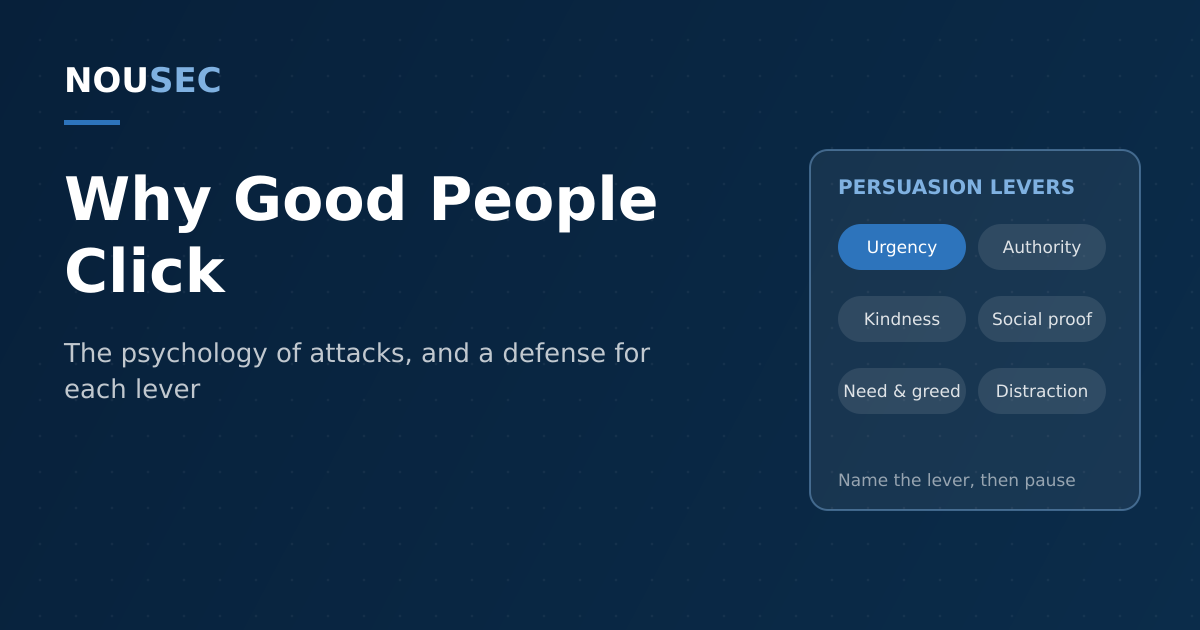
Security teams have a phrase for the moment a social engineering attack succeeds: "human error." It is a convenient label and a misleading one. When an employee approves a fraudulent payment or reads a one-time code to a caller, the attack did not exploit a random mistake so much as a habit. Trust, helpfulness, deference to senior people and the pull of a deadline are the same traits that let organizations function. Attackers have simply learned which of them to press.
Verizon's 2026 Data Breach Investigations Report found the human element involved in 62% of breaches. That figure explains why social engineering gets budget. It does not explain why so many awareness programs still underperform, and the answer is mostly psychological. Training tells people to watch for "urgency" without explaining why urgency works on careful people too. Simulations report who clicked without saying which lever they responded to. A defense built on understanding the mechanism survives the next unfamiliar lure. A defense built on a list of red flags usually does not.
The Seven Shortcuts Attackers Use
In 2011, Frank Stajano and Paul Wilson published "Understanding Scam Victims: Seven Principles for Systems Security" in Communications of the ACM. Working from how fraudsters actually operate, they described seven recurring patterns, and their conclusion reframes the whole problem:
Users fall prey to these principles not because they are gullible but because they are human.
The seven principles are distraction, social compliance, herd, dishonesty, kindness, need and greed, and time. The table below pairs each one with what the attacker is counting on and an example of how it might appear at work. The examples are illustrative and are not taken from the paper.
| Principle | What the attacker counts on | Illustrative example |
|---|---|---|
| Distraction | The target's attention is somewhere else | A fake "security alert" arriving mid-task |
| Social compliance | People cooperate with apparent authority | "The CFO asked me to confirm this is processed today" |
| Herd | People follow what others seem to be doing | "Everyone on your team has already filed the new vendor form" |
| Dishonesty | The target wants a quiet exception or a shortcut | An offer to skip approval "just this once" |
| Kindness | People want to help | A caller locked out who needs a quick password reset |
| Need and greed | A pressing need or a tempting gain | A refund, bonus or fast-tracked invoice |
| Time | Deadlines short-circuit deliberation | "The wire cutoff is in 20 minutes" |
Read the table with a security team's eyes and a pattern appears. Most attacks that reach a finance or help-desk inbox combine two or three levers. A fake supplier invoice is authority plus need plus time. A help-desk reset request is kindness plus time plus social compliance. That makes the table a diagnostic tool. When a message feels slightly wrong, the useful question is not only "is this a scam?" but "which lever is it pulling, and what would a legitimate version of this request look like?"
Where Cialdini Fits In
Stajano and Wilson's categories overlap with the six principles of influence that Robert Cialdini described in Influence (1984): reciprocity, commitment and consistency, social proof, authority, liking and scarcity. The two frameworks come from different angles. Cialdini described how persuasion works in general. Stajano and Wilson described how scams work against people in particular. Researchers have applied Cialdini's model to phishing since at least 2015, when Ferreira, Coventry and Lenzini examined the principles of persuasion in social engineering and their use in phishing. Our Cialdini principles glossary entry covers the six in more detail. The rest of this article asks a narrower question: what does the evidence say about how these levers behave in real messages?
What the 2025 Evidence Says
Most awareness training assumes people are fooled by a vague sense that something is off, and that more attention will fix it. A 2025 study from the University of Adelaide tested that assumption directly. Auton and Sturman recruited 200 participants, each of whom judged 60 emails, 50 genuine and 10 phishing. Each email was shown for either 7 seconds or 15 seconds. The emails combined persuasion principles in different ways: authority and scarcity, which were the common cues in the design, reciprocity and social proof, which were less common, and some messages with no persuasion cue at all.
Three findings stand out. Participants were most skilled at detecting phishing emails and unsafe links when the messages contained scarcity and social proof principles. More time to review each email improved detection overall, but time did not significantly change how strongly the persuasion principles worked, so the pressure of the clock and the persuasion on the page appear to be separate effects. And the authors suggest that a principle's power to deceive may not depend on how often it appears in real attacks. A lever that is rare in your mailbox can still be the one that works.
The authors' practical conclusion is direct:
Training interventions should focus on helping users recognise persuasion principles.
A caveat belongs here. The phishing sample in that experiment was small, only ten messages, and a single study should not set a control budget on its own. Treat the specific results as directional. The recommendation to teach the levers, rather than only the symptoms, is the part that fits the broader literature.
Why Good People Click
The most dangerous levers are often the most admirable traits. Kindness and social compliance are the clearest examples. A help-desk agent who wants to restore an executive's access quickly is not being careless; that instinct is exactly what help desk impersonation depends on. Attackers build pretexts around it because it is reliable. Deference works the same way. An assistant who processes a request from "the CFO" is doing the job they were hired to do, and the attack lives inside that job.
Distraction and time work differently. They are not about character at all. Attention is thinnest during month-end close, a product launch or a holiday rush, and that is when attackers tend to schedule their most urgent lures. Seasonal peaks deserve their own briefings, and our holiday season phishing guide walks through the calendar.
Dishonesty deserves its own mention, because it is the lever security programs most often ignore. An employee who has clicked a link and says nothing has given the attacker a second chance. Fear of embarrassment is a lever too, and a target who is afraid to report will often try to fix the problem alone, which is the outcome the attacker wants.
A Defense Playbook, Lever by Lever
The goal is not to train people out of being influenced. Influence is how organizations run, and an employee who ignores every request is not useful either. The goal is to make each lever trigger a pause and a procedure before anyone acts. Five practices do most of the work.
Teach the levers, not only the red flags. Show a real phishing example and ask employees to name the shortcut it uses. "This one is authority plus time" is a sentence people can carry into a new situation. "Watch out for urgency" is a warning they will forget by the following week. Naming the lever creates a reflex that interrupts a response before it completes.
Put a procedure in front of every high-impact lever. Judgment fails under pressure, so replace it with rules that do not depend on the target's confidence. Payment changes require a call-back to a number already on file. Credential resets require a verification step that a caller cannot talk past. Requests above a set threshold need a second approver outside the reporting line of the request. A written rule that no deadline can override is the structural answer to both time and authority pressure.
Simulate by lever, not only by template. A simulation program that varies templates at random tells you a click rate. One that tags each template with the lever it uses tells you which shortcuts your people respond to. Teams often prove safe against authority and exposed to time, or the reverse, and that is actionable: the next training module can target the lever that matters. Our phishing simulation platform is built around this kind of tagging.
Make the honest mistake cheap to report. Measure report rate and time-to-report as first-class signals rather than footnotes to click rate. Every employee who reports a lure quickly is a sensor that shortens the next attack. The phishing reporting culture article covers how to make reporting feel safe enough to use.
Watch for concentration by team. Look at where risk clusters. Help desks often concentrate on kindness, executive offices on deference, and accounts payable on deadlines. A Human Risk Score view by team shows whether a lever is concentrated in one function, which points to a targeted fix rather than another organization-wide module.
What to Take Away
Attackers do not need a zero-day when a well-timed request will do. The psychology behind social engineering is not a flaw to be trained out of people; it is the same social machinery that makes teams work. Defenses that assume people will simply be more alert will keep failing, because alertness is the first thing a good lure is designed to take. Defenses that name the lever, put a procedure in front of it and measure which levers still work hold up far better. For the broader framework, start with what human risk management is and the statistics behind the human element.
Sources
- Stajano, F. and Wilson, P., "Understanding Scam Victims: Seven Principles for Systems Security," Communications of the ACM, 54(3), 2011. Source of the seven principles and the "not because they are gullible" passage.
- Auton, J. C. and Sturman, D., "Persuasion under pressure: the influence of persuasion principles and time constraints on phishing email susceptibility," Information and Computer Security, 33(5), 2025. Experiment with 200 participants, 60 emails, and 7-second and 15-second review conditions.
- Ferreira, A., Coventry, L. and Lenzini, G., "Principles of Persuasion in Social Engineering and Their Use in Phishing," 2015. Application of persuasion principles to phishing.
- Verizon, 2026 Data Breach Investigations Report. Human element involved in 62% of breaches.
- Cialdini, R. B., Influence (1984). Origin of the six principles of persuasion.
Frequently asked questions
What psychological principles do social engineering attacks use?
Two frameworks are the most useful. Stajano and Wilson's 2011 analysis of scam victims describes seven principles: distraction, social compliance, herd, dishonesty, kindness, need and greed, and time. Cialdini's six principles of influence, which are reciprocity, commitment, social proof, authority, liking and scarcity, describe the persuasion mechanics behind many lures. Most real attacks combine several levers at once, which is why a single checklist of red flags rarely covers them.
Can security awareness training make people immune to persuasion?
No, and it should not aim for immunity. The realistic goal is recognition plus procedure. People who can name the lever in a message are more likely to pause, and a verification step turns that pause into a decision. A 2025 study by Auton and Sturman concluded that training should focus on helping users recognise persuasion principles, which is a more achievable target than immunity.
Which persuasion principle is the most dangerous?
No single principle clearly dominates, and the evidence argues against ranking them. In the 2025 experiment, participants were most skilled at detecting phishing emails that contained scarcity and social proof, but the authors note that a principle's power to deceive may not depend on how often it appears in real attacks. The practical approach is to test every lever your organization faces in simulation and to put procedures in front of the high-impact ones, such as payment changes and credential resets.
How do I use these principles in phishing simulations?
Tag every simulation template with the principle or principles it uses, then compare failure and report rates by lever rather than only by template. If a team fails under time pressure but holds up against authority, the next training module should target time-pressure requests. Results broken down this way are easier to explain to leadership than an overall click rate, and they point directly at what to teach next.
NOUSEC simulates attacks across 8 channels and turns the results into one number your board can read.
Book a demo