What Is Human Risk Management? A Practical Guide for Security Teams
Human risk management (HRM) goes beyond annual awareness training: it continuously measures, scores, and reduces the risk created by how employees respond to real-world social engineering.
Firewalls, EDR, and email gateways keep getting better — and attackers have responded by going around them. The Verizon 2026 Data Breach Investigations Report attributes 62% of breaches to the human element: someone clicked, someone was tricked, someone reused a password. Technology alone does not fix that, and neither does an annual compliance video.
Human risk management (HRM) is the discipline that treats people the way security teams already treat infrastructure: as an attack surface that can be measured, scored, and hardened — continuously, with data.
The problem with traditional security awareness
Most organizations run security awareness the same way they did a decade ago: a yearly training module, a quarterly phishing test, and a completion report for the auditor. Three structural problems make this model ineffective:
- It measures activity, not outcomes. Completion rates tell you who watched a video, not who would wire money to a fraudster tomorrow.
- It tests one channel. Attackers moved to voice calls, SMS, QR codes, and deepfake audio years ago. According to CrowdStrike's 2025 Global Threat Report, voice phishing (vishing) attacks surged 442% between the first and second half of 2024. An email-only test simply misses most of the modern attack surface.
- It produces no risk signal. A pass/fail phishing click rate cannot be compared across departments, trended over time, or presented to a board next to other risk KPIs.
What human risk management actually means
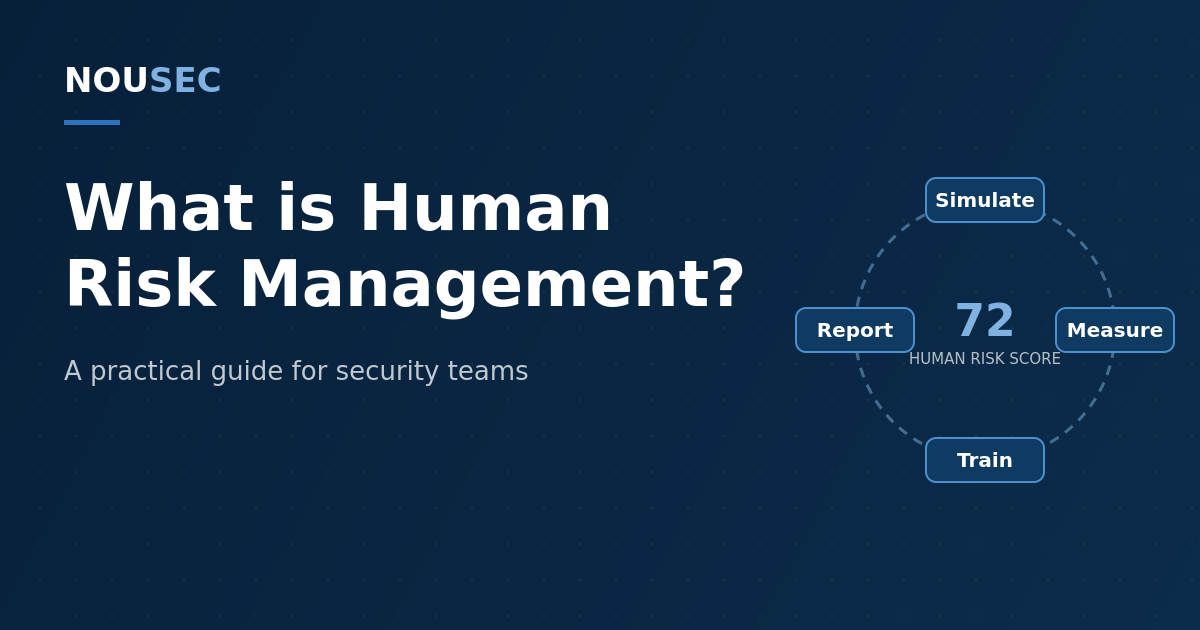
HRM closes that gap with a continuous loop — the same loop your vulnerability management program already uses, applied to people:
1. Simulate real attacks, across every channel
Instead of one templated email blast, an HRM program runs randomized, realistic simulations across the channels attackers actually use: email phishing, smishing, vishing, deepfake voice calls, WhatsApp lures, QR code drops, USB baiting, and callback scams. The ENISA Threat Landscape consistently ranks social engineering among the top threats in Europe precisely because it adapts channels faster than defenses do.
2. Measure how people really behave
Every simulation produces behavioral data: who engaged, who ignored, who reported. Reporting is the metric that matters most — a workforce that reports suspicious contact quickly turns your employees from a vulnerability into a detection network.
3. Quantify risk with a single score
The data rolls up into a Human Risk Score — per employee, per department, per organization. That single number is what makes human risk manageable: it can be trended, benchmarked, and reported to leadership alongside patch compliance and endpoint coverage.
4. Train only where the data says so
Adaptive micro-training goes to the people who need it, on the channel where they struggled, at the moment of failure — not to the whole company on an arbitrary schedule. This keeps training minutes low and behavior change high.
The shift in one sentence: awareness programs count who finished training; human risk management measures who would fall for the next real attack — and fixes that.
Why this matters more in 2026
Generative AI removed the last friction from social engineering. Verizon's 2026 DBIR notes that the median threat actor now applies AI across 15 documented attack techniques, and deepfake-enabled fraud is projected by Deloitte to reach $40 billion in losses by 2027. Perfectly written lures in any language, cloned executive voices, and automated multi-channel campaigns mean the "spot the typo" era of awareness training is over.
Meanwhile, regulators keep raising the bar. GDPR, NIS2, DORA, and ISO 27001 all expect demonstrable, risk-based security training — and "risk-based" is exactly what a completion certificate cannot demonstrate. Frameworks such as NIST SP 800-50r1 now explicitly push organizations toward measurable awareness program outcomes.
How to start a human risk management program
You do not need to boil the ocean. A pragmatic rollout looks like this:
- Baseline quietly. Run a first wave of multi-channel simulations without announcements to establish an honest baseline score.
- Score and segment. Identify the highest-risk departments and roles — finance and executive assistants typically top the list for pretexting and deepfake attempts.
- Fix reporting first. Make "report it" a one-click action and celebrate reporters. Reporting rate improves faster than click rate and pays off in real incidents.
- Automate the loop. Move from campaigns to continuous sampling so your Human Risk Score becomes a stable monthly metric.
- Report upward. Put the score in the same dashboard as your other risk KPIs. When the board can see human risk trending down, the program funds itself.
Where NOUSEC fits
NOUSEC was built for exactly this loop: it simulates attacks across 8 channels — including deepfake voice — measures real employee behavior, and unifies the results into one Human Risk Score your board can read. If you want to see what your organization's score looks like, book a demo.
Frequently asked questions
How is human risk management different from security awareness training?
Security awareness training pushes content to employees on a schedule. Human risk management is outcome-driven: it continuously simulates real attacks, measures how people actually respond, quantifies that risk per employee and department, and applies targeted training only where the data shows it is needed.
What is a Human Risk Score?
A Human Risk Score condenses simulation results, reporting behavior, and exposure factors into a single number for an employee, a department, or the whole organization — so leadership can track human risk the same way they track vulnerability or endpoint metrics.
Which attack channels should human risk management cover?
Modern social engineering is multi-channel. A complete program covers at least email phishing, SMS (smishing), voice calls (vishing), deepfake audio, WhatsApp and messaging lures, QR code phishing (quishing), USB drops, and callback scams.
How often should you run social engineering simulations?
Continuously, in small randomized waves, rather than one big annual campaign. Continuous sampling produces a stable, trendable risk metric and avoids the office-wide warning effect of a single mass test.
NOUSEC simulates attacks across 8 channels and turns the results into one number your board can read.
Book a demo