The Story Is the Attack: Why Believable Requests Get Through
Pretexting builds a convincing story to get past employees. How the tactic works, why help desks are targeted, and the verification steps that hold up.
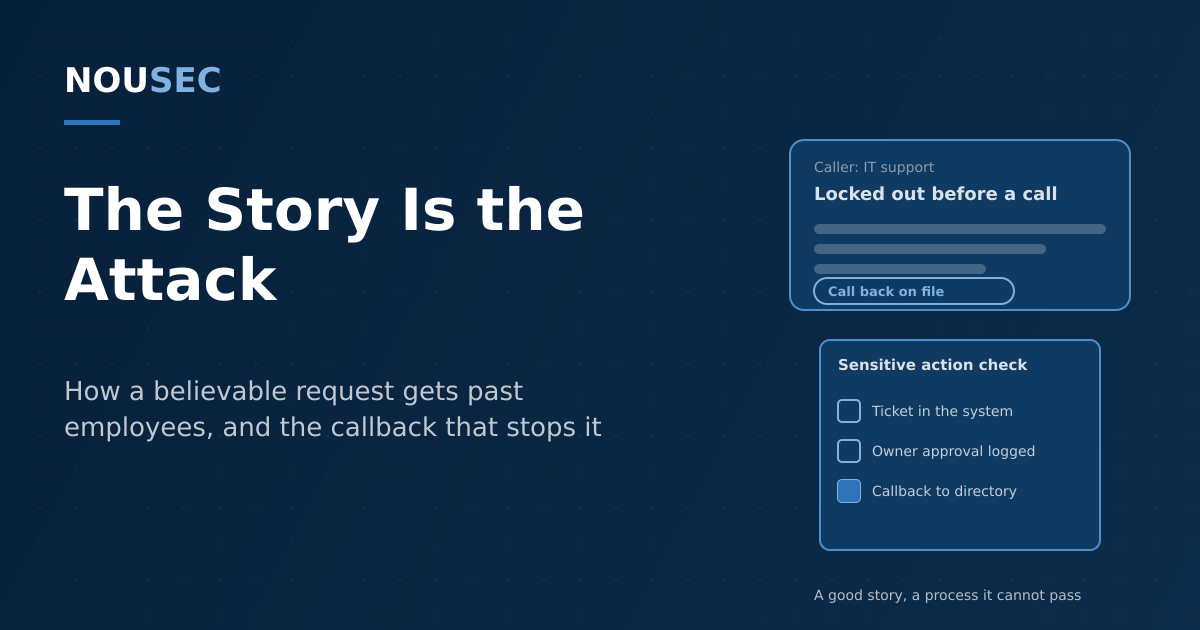
Every help desk has heard a version of the same call. The caller is on a plane, or their phone just died, or they are in a client meeting that starts in ten minutes and they need a password reset right now. The person on the line sounds like they belong at the company. They mention a manager by name, refer to a project, and know which building the team sits in. Nothing about the call is technically sophisticated. It works because the story hangs together, and a coherent story is hard to argue with when the person telling it sounds stressed.
That story is the pretext, and building it is the craft of pretexting. The 2026 Verizon Data Breach Investigations Report describes pretexting as an attacker tactic in which a trusted relationship is built through concocted scenarios to trick the user into taking an action that compromises the organization. The report also puts a number on how common it has become: pretexting reached 6% of all breaches in its dataset, and it is now a more common initial access vector for ransomware and extortion attacks than it was. Six percent sounds small until you remember that every one of those breaches began with a conversation that someone believed.
What a pretext is made of
A pretext has three parts, and each one can be assembled from public information.
The first is the identity: someone the target expects to hear from. That might be IT support, a vendor's account manager, a new manager who needs access set up, an auditor, or a senior executive travelling without their laptop. The attacker chooses an identity that fits the target's role so that the request feels like ordinary work.
The second is the scenario, the reason the request is normal today. A system migration, a lockout after a password expiry, an audit deadline, a shipment that has to clear by five o'clock. The scenario explains why the request is unusual and why it cannot wait, and it gives the target a reason to help that feels like being a good colleague.
The third is the proof: the details that make the identity credible. Names of managers, project codenames, org structure, the vendor's real invoice format, the time zone of the office. Much of this comes from professional networking profiles, company websites and earlier conversations. The more accurate the context, the harder the pretext is to question, which is why pretexting attacks often include research that feels disturbingly specific.
Pretexting is not a single channel. It can be a phone call, a Teams chat, an email thread that appears to continue an earlier conversation, or an in-person visit. What unites the forms is that the attacker is performing a role and waiting for the target to accept it.
The help desk is a favorite stage
Help desks are attractive targets because their job is to be helpful, quickly, to people who cannot do their work without access. A joint advisory from CISA and the FBI on the Scattered Spider group, AA23-320A, describes actors who "posed as company IT and/or helpdesk staff using phone calls or SMS messages" and used social engineering "to convince IT help desk personnel to reset passwords and/or MFA tokens." Once a reset is granted, the attacker does not need to break anything. They log in as the employee.
The mechanics are simple, and that is the point. The help desk agent is trying to resolve a ticket, the caller is trying to get back into their account, and both want the same outcome. Without a verification step that the attacker cannot complete, the easiest path is the one the agent takes to be helpful. Our help desk impersonation guide covers the 2025 lawsuit over a 2023 compromise, in which the complaint alleges the agent never verified that the caller was the employee they claimed to be.
The table below shows how common pretexts map onto channels and onto the one check that should always happen before anything changes.
| Pretext | Typical channel | What the attacker wants | Verification that holds |
|---|---|---|---|
| IT support after a lockout | Phone or Teams | Password or MFA reset | Reset only through the ticketing system, with a callback to the number on the employee record |
| Vendor with a billing update | Changed bank details | Call the vendor on a number already on file, not one in the message | |
| New manager needing access | Chat | Access to a shared folder or system | Approval from the system owner inside the access management tool |
| Auditor or regulator | Phone or email | Employee records or account lists | Confirm the engagement with the compliance lead before releasing anything |
| Executive travel emergency | Text or WhatsApp | Gift cards or an urgent wire | Out-of-band check with the executive through a known channel |
Why verification usually fails
Most verification steps fail because they check the wrong thing. "Do you recognize the voice?" is weak, and it is getting weaker as voice cloning becomes cheap. "Does the caller know my manager's name?" is also weak, because the attacker researched the manager's name before the call. A verification question that the attacker can answer from public data is not a verification question at all.
Stronger checks ask about process rather than knowledge. Did this request arrive through the ticketing system that the organization uses for resets? Is there an approval from the person who owns the system being accessed? Can the action be completed only on a device of record that the employee already controls? A pretext is weak when it must pass through steps the storyteller cannot control. Our deepfake voice guide explains why voice recognition should never be the last line of defense for a payment or a password reset.
A pretext is not defeated by spotting the lie. It is defeated when the request has to pass through a step the storyteller cannot control.
How to defend against pretexts
The first step is to decide which actions are sensitive enough to require a process rather than judgment. Credential and MFA resets, changes to payment details, grants of privileged access, and release of personal data are the usual list. Everything else can be handled with ordinary professional courtesy. Writing the list down matters, because staff who have to guess which requests are sensitive will treat most of them as routine.
For sensitive actions, verify out of band. That means hanging up and calling back on a number from the company directory, not the number the caller provided, and confirming an email request through a separate channel rather than by replying to the same thread. The principle is explained in our glossary entry on out-of-band verification, and it is the single most effective habit against pretexting because it breaks the attacker's control of the conversation.
Script the help desk. A good script requires a verification step that depends on something the attacker cannot get from public sources, such as a one-time code sent to the device of record, and it tells agents explicitly that refusing to proceed without verification is correct behavior. Agents should never be told to make an exception for a caller who is senior, urgent or upset. Those are the features of a pretext, not reasons to bypass the process.
Give staff permission to pause. Pretexts depend on urgency, and urgency is hard to resist in the moment. A written rule that any sensitive request can wait thirty minutes for a callback removes the pressure the attacker is relying on. The rule should be explicit enough that nobody has to ask whether it applies, and it should be backed by managers who do not punish a delayed request.
Simulate multi-step scenarios. A single suspicious email tests recognition of a phishing message, but it does not test whether someone will hold their position across a sustained conversation. Simulations that run a pretext over two or three interactions, with a plausible follow-up, show where people give way. Our phishing simulation best practices guide covers how to run these tests without damaging trust.
Finally, measure the right thing. Clicks on a test link are one signal. Reports of unusual requests are another, and often a more useful one. A team that reports a suspicious call to the security desk within minutes is doing the work that stops a pretext, even if it was not the person who first doubted the story. The human risk score approach tracks this kind of reporting behavior alongside susceptibility, so that the picture reflects how teams respond, not just how they fall for a test.
Why the story is the hardest part to train
Training usually focuses on red flags: misspelled domains, strange requests, unexpected attachments. Pretexts do not need red flags. They are built to look like ordinary work, and the training that works best explains the pattern rather than the example. People who understand that an attacker is trying to build trust, and that trust is what the process is designed to check, are better at recognizing a pretext they have never seen before. Our social engineering psychology guide describes why people accept a plausible story, and why the answer is structural rather than a matter of being more careful.
Pretexts will keep getting better, because the research they depend on is cheap and the tools for writing convincing messages keep improving. The defense that holds is the one that does not depend on anyone's ability to see through a good story. Decide which requests are sensitive, verify them through a channel the caller does not control, and give staff the permission to wait. The attacker can write any story they like. They cannot make the process run faster for them.
Sources
- Verizon, 2026 Data Breach Investigations Report, executive summary. Source for the pretexting definition, the 6% share of all breaches, and the ransomware and extortion initial access finding.
- CISA and FBI, Cybersecurity Advisory AA23-320A, Scattered Spider. Source for the description of attackers posing as IT or help desk staff and the help desk reset activity.
Frequently asked questions
What is pretexting?
Pretexting is a social engineering tactic in which an attacker invents a believable scenario and an identity, such as IT support or a vendor, to persuade a target to share information or take an action. The 2026 Verizon DBIR describes it as a trusted relationship built through concocted scenarios, and the attacker's power comes from the story rather than from any technical exploit.
How is pretexting different from phishing?
Phishing is usually a single message sent to many people. Pretexting is a crafted story, often delivered over several interactions by phone, chat or email, and tailored to one target. A phishing email can contain a pretext, but pretexting does not need a malicious link or attachment at all.
Why are help desks a common pretexting target?
Help desks exist to resolve urgent requests quickly, and they can reset passwords or MFA for people who cannot log in. CISA and the FBI have described attackers posing as IT or help desk staff to convince support personnel to reset passwords and MFA tokens. A request that sounds routine and urgent is exactly what a help desk is built to handle.
What is the most effective defense against pretexting?
Verification that does not depend on the caller's story. Sensitive actions such as credential resets, payment changes and access grants should require a callback to a number already on file, approval through a ticketing or workflow system, or a second person. Staff should also have written permission to pause a request that feels urgent.
NOUSEC simulates attacks across 8 channels and turns the results into one number your board can read.
Book a demo