Your Org Chart Is Public: What Attackers Learn Before the First Message
Attackers build targeting profiles from public employee data before any lure is sent. How open-source research works and how to audit your exposure.
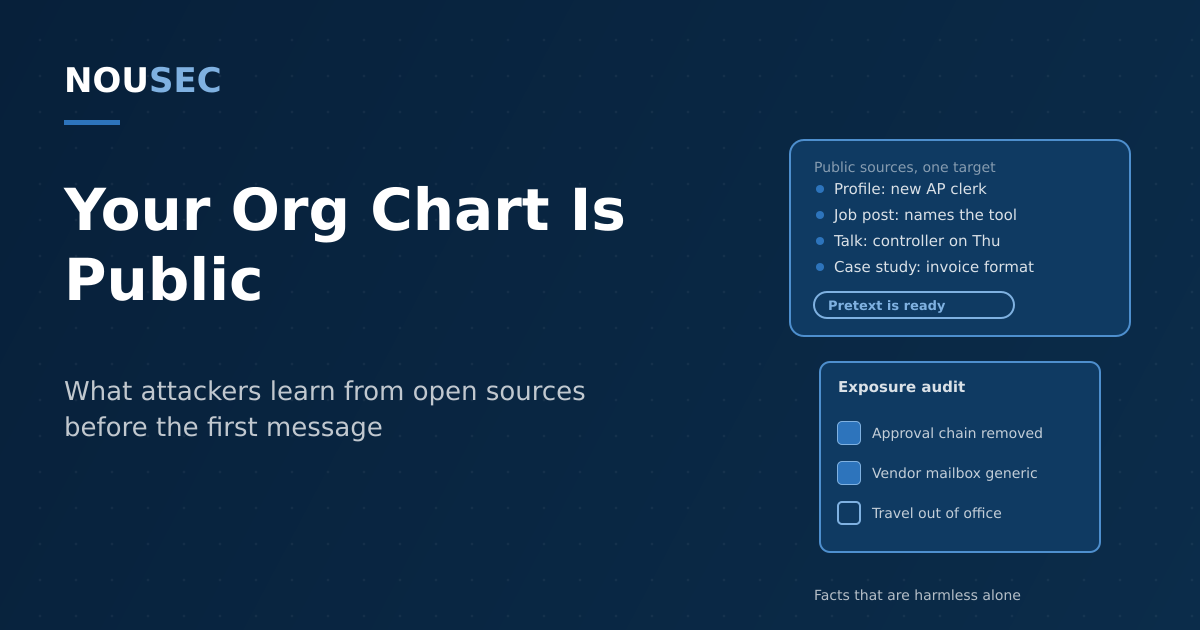
The email arrives on a Tuesday. It mentions the controller's trip to a regional finance conference, refers to a vendor onboarding project announced last month, and greets the new accounts payable clerk by her first name. Nobody inside the company shared any of it. Every fact came from a public page: a conference agenda, a press release, a job posting, and a professional profile that was updated the week the clerk started.
That research step has a name. Open-source intelligence, or OSINT, is information gathered from public sources, and it is the reconnaissance phase of nearly every targeted social engineering attack. Our pretexting guide explains how a believable story is delivered and verified. This one looks at where the story comes from, and at what an organization can change about the material that feeds it.
The cost of that research has fallen sharply. In a 2024 academic study by Heiding, Lermen, Kao, Schneier and Vishwanath, an automated pipeline gathered open-source information on each target, built a personalization profile that was accurate and useful in 88% of cases, and wrote the lure. The fully automated spear phishing emails reached a 54% click-through rate, on par with human experts and far above the 12% of the generic control group. The authors estimate the economics at a fraction of what manual campaigns cost. The research no longer needs a skilled investigator. It needs an afternoon and a list of targets.
What the public record gives away
Almost none of the sources in the table below is a security failure on its own. Each one is a normal part of hiring, selling, buying or building a product. The risk comes from combining them.
| Public source | What it reveals | Why an attacker cares |
|---|---|---|
| Professional networking profiles | Org chart, job titles, tenure, promotions and new joiners | Shows who approves payments, and who is new enough not to know the norms |
| Job postings | Internal tools, vendors, open roles and team size | Supplies system names that make a fake IT or vendor message convincing |
| Press releases and investor material | Deals, project timelines, executive names and travel | Provides urgency and a plausible reason for an unusual request |
| Conference agendas, talks and podcasts | Speaker names, projects, travel dates and voice samples | Explains why an executive cannot be reached, and supplies audio for voice cloning |
| Domains and email conventions | Address format, mail provider and public contact addresses | Lets an attacker produce a plausible sender or lookalike domain |
| Public code and documentation | Internal hostnames, product names and portal URLs | Makes a fake login or support request look like it came from inside |
None of these requires an intrusion. They are read in a browser by anyone who looks, and an attacker with a few hours can assemble the picture that a recruiter would take a week to build.
How fragments become a pretext
Consider a composite scenario, not a documented case. A new accounts payable clerk is announced on a professional network on Monday. A job posting from the spring named the procurement platform the team uses. A vendor's public case study describes its invoice format. The controller is listed as a speaker at a conference on Thursday. By Wednesday, an attacker has a name, a role, a system, a trusted vendor and an approver who is out of reach. The message they send needs no technical trick. It only needs to sound like someone who was already expected to write.
Each fragment was public and harmless. Combined, they produce the kind of specific detail that makes a request feel routine. This is why generic warning signs, such as odd grammar or an unknown sender, do so little against research-driven attacks. When a message contains accurate and specific information, the usual red flags are missing.
Attackers rarely need secret information. They need connections between facts that were each published for a different reason.
The 2026 Verizon Data Breach Investigations Report, which covers breaches between October 2024 and November 2025, found the human element present in 62% of breaches, up from 60% the year before. Social engineering was the third most common breach pattern, at 16% of all breaches. Pretexting, the story-driven form of the attack, appeared in 6% of breaches, and the report notes that it has become a more common initial access vector for ransomware and extortion. Reconnaissance is the quiet input to all of those numbers.
How to audit your public exposure
An exposure audit is a bounded exercise. It is not an investigation of people's private lives, and it should be scoped and approved before anyone starts. The steps below take a few hours per quarter.
- Choose the roles that matter most. Finance approvers, accounts payable, the help desk, executive assistants and the executives themselves are the usual starting points. Agree the list in advance so that the exercise stays focused on business exposure.
- Search only what an outsider could find. Spend a fixed amount of time per role, perhaps an hour, looking at professional profiles, job postings, press releases, conference listings, public documents, public code repositories and your own website's contact pages. Do not log in anywhere, and do not contact anyone.
- Sort each finding by what it enables. Group the results into four types: identity (who the person is), timing (when they are away or busy), process (who approves what, and how payments or password resets work) and technology (which systems, vendors and domains are named).
- Reduce the process and timing details first. Titles and tenure on a profile are usually acceptable. Approval chains, payment workflows, detailed travel plans, and out-of-office messages that name a destination and a return date are the items to change.
- Standardize how the outside world reaches you. Use generic mailboxes for vendors, publish contact paths that do not reveal the internal address format, and write out-of-office templates that say someone is unavailable without saying where they are.
- Retest on a schedule. Publication changes constantly, from new hires to conference talks, so a one-time audit decays the way annual training does. Treat the audit as a recurring control.
The goal is not to make the company invisible. Recruiting and sales need visible people, and a job posting that names the tools is the price of hiring engineers who already know them. The aim is to remove the details that give an attacker an operational advantage, and to keep the rest.
Make reporting part of the defense
Two parts of the program matter most. The first is teaching staff that the quality of a message is not evidence of its legitimacy. A caller who knows the controller's conference schedule is more convincing, not more trustworthy. A pretext built on public facts is designed to feel safe, so the verification step has to be the thing that decides, whatever the caller knows.
The second is making the reporting signal explicit. The UK National Protective Security Authority, which advises people who face a higher risk of targeting, puts the underlying problem plainly: "Social media accounts can present valuable information that can be exploited by anyone wishing to target you." Its guidance is written for high-risk individuals, but the logic applies to every executive and every finance approver. An employee who says "this caller knew too much about our team" has identified exactly the reconnaissance pattern the security team needs to see. Those reports belong in the same measurement as simulation outcomes. Tracking them in a human risk score shows whether reporting improves as the program matures, which matters more than whether people avoid a single test.
Simulations can use the same technique. A test built from the public record of your own organization, such as a lure that refers to a real conference or a real vendor, shows employees how convincing a researched message can be. Our phishing simulation guidance explains how to design those tests without damaging trust, and the social engineering statistics page collects the broader data behind the threat.
Start with one role
The research an attacker does before a message costs very little, and it produces results that look like insider knowledge. A defense does not have to make every fact private. It has to make sure that a well-researched request still has to pass a verification step the attacker cannot complete, and that people notice when a stranger knows more than a stranger should.
Start with one role this quarter. Spend an hour on what the public record shows about it, remove the process and timing details that do not need to be public, and check that the verification steps for that role work even when the caller knows everything the search returned. Then repeat the exercise for the next role.
Sources
- Verizon, 2026 Data Breach Investigations Report, executive summary. Source for the 62% human element figure, the 16% social engineering share, the 6% pretexting share and the ransomware and extortion initial access finding.
- Heiding, Lermen, Kao, Schneier and Vishwanath, Evaluating Large Language Models' Capability to Launch Fully Automated Spear Phishing Campaigns, arXiv, 2024. Source for the automated OSINT profile accuracy and the click-through comparison with human experts and the generic control group.
- National Protective Security Authority (UK), Protect Information About You, last updated 15 April 2024. Source for the quoted guidance on valuable information that social media accounts can reveal to anyone wishing to target a person.
Frequently asked questions
What is OSINT in a social engineering attack?
OSINT, or open-source intelligence, is information collected from publicly available sources such as professional profiles, job postings, press releases, conference listings and public code repositories. In social engineering it is the reconnaissance stage: attackers use it to choose targets and to build pretexts that include accurate names, roles, projects and timing.
Is it appropriate to use OSINT to review our own exposure?
Reviewing what an outsider can find about your organization is standard practice, but it should have a written scope and approval from legal and HR before it starts. Keep it to public sources and to business roles rather than people's private lives. This is general guidance, not legal advice, so check the approach with your counsel.
Should we remove employee names and job titles from public sites?
Not in general. Names and roles support sales, recruiting and trust. The better target is operational detail: approval chains, payment workflows, travel schedules, internal tools and the address format used for staff email. Route vendor and external contact through generic mailboxes and keep out-of-office messages free of destinations and return dates.
How often should an exposure review be repeated?
Quarterly is a practical cadence for finance, payroll, help desk and executive roles, because new hires, conference talks and job postings change constantly. An annual review will miss most of what has been published in the meantime.
NOUSEC simulates attacks across 8 channels and turns the results into one number your board can read.
Book a demo