The Scams That Follow Your Employees Home
Consumer fraud hit a record $15.9 billion in 2025, and holiday scams target employees directly. Why that is a workplace risk — and what to do about it.
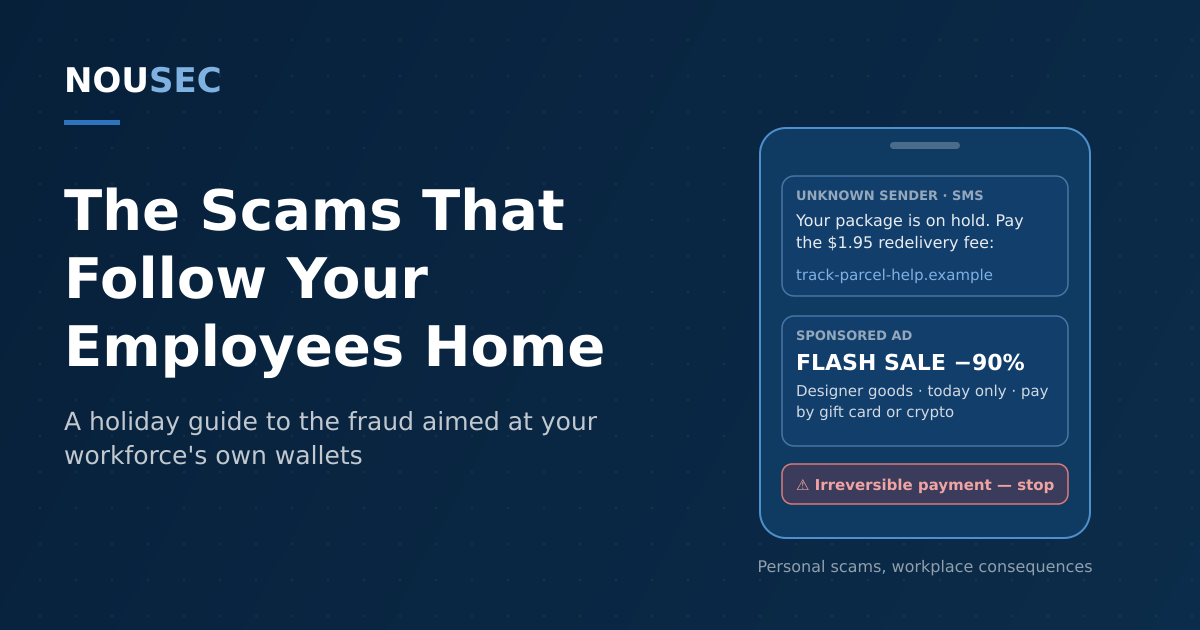
Security teams spend November hardening the company against the Q4 phishing surge — the fake invoices, executive gift card requests, and delivery lures that arrive on work channels. That guide covers the attacks aimed at the organization. This one covers the other half of the season: the fraud aimed directly at your employees' own wallets, on their own time, through their own phones.
The scale of that fraud stopped being a footnote some time ago. The US Federal Trade Commission told Congress in March 2026 that consumers reported losing more than $15.9 billion to fraud in 2025 — a record, up 27% from 2024's $12.5 billion, and roughly five times what was reported in 2020. The FBI's Internet Crime Complaint Center counted $20.9 billion in reported cybercrime losses for the same year. None of those losses show up in a SIEM, and almost none of them happened on a corporate network. They still belong in your threat model.
Consumer scams are a workplace risk because the boundary they cross is a person, not a network. Employees receive scam texts on the phone that holds their corporate authenticator, reuse passwords between counterfeit checkouts and work accounts, suffer financial distress that precedes insider risk, and get recruited by fraud rings impersonating employers — sometimes yours. A security awareness program that stops at the corporate inbox trains half the attack surface the employee actually lives on.
Why personal fraud is a professional problem
The channels are shared. A fake delivery text is a consumer scam when it harvests a card number and a corporate attack when the same smishing infrastructure delivers a credential-phishing page to the same device on Monday. The Verizon DBIR attributes 62% of breaches to the human element; nothing about that element resets when the employee leaves the building.
Financial harm precedes insider risk. An employee quietly absorbing a five-figure loss to a task scam or a long-con investment fraud is under exactly the kind of pressure that classic insider threat models flag — and shame keeps most victims silent. Some scams go further and make the victim an accomplice: "payment processing" side gigs are a standard recruitment funnel for money mule networks, which can put an employee's — and by extension an employer's — accounts inside a laundering chain.
The attackers wear your brand. Fake recruiters post jobs under real company names, and boss-imposter scams contact new hires before their first day. When the lure misuses your name, the line between consumer protection and brand defense disappears entirely.
The reflexes transfer. Verifying through a known channel, treating urgency plus secrecy as a stop signal, refusing gift cards, wire, and crypto as payment rails — the habits that protect an employee's savings in December are the same ones that protect your treasury in March. Training them in a personal context, where motivation is highest, is the cheapest behavior change in security.
A scam that empties an employee's savings in December is not outside your perimeter. It lives in your workforce — in the same person, on the same phone, with the same habits you depend on at work.
The holiday lineup
The giving-and-spending season concentrates a predictable set of schemes. The FBI's recent holiday warnings span email, social media ads, fake retail sites, QR codes, and phone calls — the useful mental model for employees is a short catalog of patterns, each with one disqualifying tell.
| Scam | Usually arrives as | The disqualifying tell |
|---|---|---|
| Fake delivery notice | Text or email: "package held, fee required" | Carriers do not collect fees or credentials by text link |
| Fake online store | Social media ad or search result with extreme discounts | Store exists only behind one link; wants wire, crypto, or gift cards |
| Gift card or charity appeal | Urgent message from "boss," "HR," or a relief campaign | Irreversible payment rails; pressure plus secrecy |
| Seasonal task scam | WhatsApp/Telegram offer of easy paid online tasks | You must deposit your own money to "unlock" earnings |
| Brushing package | Unordered parcel with a QR code inside | Scanning a code from a package you never ordered |
| Grandparent scam | Distressed call from a "relative," increasingly voice-cloned | Urgency, secrecy, and payment by card codes or courier |
| Card skimming and triangulation fraud | Tampered readers; marketplace bargains fulfilled oddly | Loose or bulky card slots; goods shipped direct from a retailer you never bought from |
Three of these deserve a closer look, because they are growing fastest.
Task scams are the growth story. The FTC's data spotlight Paying to get paid tracked reports of gamified online-job scams from zero in 2020 to 5,000 in 2023, then quadrupling to about 20,000 in just the first half of 2024 — with overall job-scam losses topping $220 million in those six months and cryptocurrency, the scammers' rail of choice, carrying $41 million of it. The holiday angle writes itself: seasonal gig work is expected, budgets are stretched, and "earn extra for the holidays" is the year's most plausible recruitment pitch.
Imposter scams set a record. The FTC logged $3.5 billion lost to imposter scams in 2025 — fraudsters posing as government agencies, businesses, tech support, and family members. The family-emergency variant is the cruelest and the most relevant to the season, when travel and gatherings make "I'm stranded, don't tell Mom" calls plausible. AI voice cloning has sharpened it: McAfee's research found some tools produce a convincing match from three seconds of audio, and the FBI now recommends families agree on a verification phrase — the same out-of-band discipline your finance team uses for payment changes, applied at the kitchen table.
Text remains the attackers' favorite consumer channel. The FTC counted $470 million in reported losses to text scams in 2024, with fake package-delivery notices among the top lures — and older adults are hit hardest across categories: complainants over 60 reported $7.75 billion in losses to the IC3 in 2025, which matters to employers because those victims are your employees' parents, and the household fallout arrives at work regardless.
What a security team should actually do
This is not an argument for policing employees' private lives. It is an argument for extending the awareness program you already run to the threat surface your people actually face — which costs little and pays back in exactly the behaviors you want on corporate channels.
- Run a seasonal micro-briefing, now. Fifteen minutes, the catalog above, one slide per scam, each with its single disqualifying tell. Employees forward this kind of content to their families — which is the point. Behaviors rehearsed at home are behaviors you inherit at work.
- Teach the three universal tells, not thirty scam types. Nearly every scheme in the catalog fails one of three tests: you must pay to receive money; the payment rail is irreversible (gift cards, wire, crypto, courier-collected cash); or the request combines urgency with secrecy. Three rules cover the category — this season's variants and next season's.
- Put seasonal consumer lures in your simulations. Delivery notices, order confirmations, and discount offers are what real attackers send your employees at work in Q4. Simulating them — including on SMS, where consumer reflexes are weakest — measures whether the briefing landed. Keep genuinely distressing pretexts out; a fake family emergency teaches resentment, not vigilance.
- Open the reporting channel to personal scams. An employee who reports a scam text from their personal phone is handing you threat intelligence and demonstrating exactly the reflex you want rewarded. Make clear the channel is blame-free and that personal reports count — reporting behavior is the strongest signal in a Human Risk Score, wherever it is practiced.
- Publish how your company contacts people. A short public statement — which domains you email from, that recruiters never charge fees, that no executive will ever ask for gift cards — protects your employees, your candidates, and your brand with one page. Monitor for lookalike job postings misusing your name.
- Brief finance and HR on the crossover schemes. Task scams become money mule cases; marketplace triangulation fraud turns employees into unwitting handlers of stolen-card goods; the long-con playbook that targets consumers also targets corporate finance teams. The teams most exposed to the corporate versions should know the consumer versions cold.
The season's real lesson
Every December, some portion of your workforce gets a live, high-stakes lesson in social engineering — delivered by criminals, graded in their own savings. The organizations that treat that as relevant security telemetry, and spend one briefing turning it into transferable habits, start January with a measurably more skeptical workforce. The ones that file it under "personal problem" train employees to believe security guidance only applies between nine and five — a distinction attackers have never once respected.
Sources
- FTC testimony before the Joint Economic Committee, March 2026 — record $15.9 billion in reported consumer fraud losses for 2025, up 27% from 2024.
- FTC press release, June 2026 — $3.5 billion reported lost to imposter scams in 2025.
- FTC press release and data spotlight Paying to get paid, December 2024 — task-scam report trajectory (0 → 5,000 → ~20,000) and $220M+ job-scam losses in H1 2024.
- FTC press release, April 2025 — $470 million reported lost to text scams in 2024.
- FBI IC3 2025 Internet Crime Report — $20.9 billion in reported losses; $7.75 billion reported by complainants over 60.
- TechRepublic, December 2025 — multichannel characterization of the FBI's holiday scam warnings.
- Verizon 2026 Data Breach Investigations Report — 62% of breaches involved the human element.
Frequently asked questions
Why should security teams care about scams that target employees' personal lives?
Four reasons. The channels are shared: the personal phone that receives a fake delivery text also holds the corporate authenticator app. The consequences cross over: an employee defrauded of savings is a classic insider-risk precursor, and some scams recruit victims into money mule activity that implicates their employer. The attackers impersonate your brand: fake recruiter and boss-imposter scams use your company's name against your own people. And the defensive habits are identical — verifying out of band, distrusting urgency, refusing irreversible payment rails — so training them anywhere strengthens them everywhere.
What are the most common holiday shopping scams right now?
Fake delivery notifications by text, counterfeit online stores promoted through ads and social media, gift card and charity appeals, seasonal task scams recruiting for fake online gig work, brushing packages carrying QR codes, family-emergency calls increasingly backed by AI voice cloning, and payment-card skimming at busy checkout points. The FTC reported a record $15.9 billion in consumer fraud losses for 2025, with imposter scams alone accounting for $3.5 billion.
How can employees spot a fake online store?
Navigate independently instead of following the ad: open the retailer's site from a bookmark or a typed address, not from a social media ad or search result. Treat extreme discounts on scarce or branded goods as the primary red flag, check that the domain matches the brand exactly, and refuse any store that asks for payment by wire transfer, cryptocurrency, or gift cards — legitimate retailers take cards, which can be disputed. A storefront that exists only behind one link is the pattern itself.
Should phishing simulations include consumer-style lures?
Yes, within clear ethical bounds. Delivery notifications, order confirmations, and seasonal discount themes are among the most-clicked simulation templates precisely because real attackers use them against employees at work. Simulating them on corporate channels teaches the reflex where you can measure it. Personal channels and genuinely distressing pretexts — fake family emergencies, for example — should stay out of simulations; cover those through briefings instead.
NOUSEC simulates attacks across 8 channels and turns the results into one number your board can read.
Book a demo